
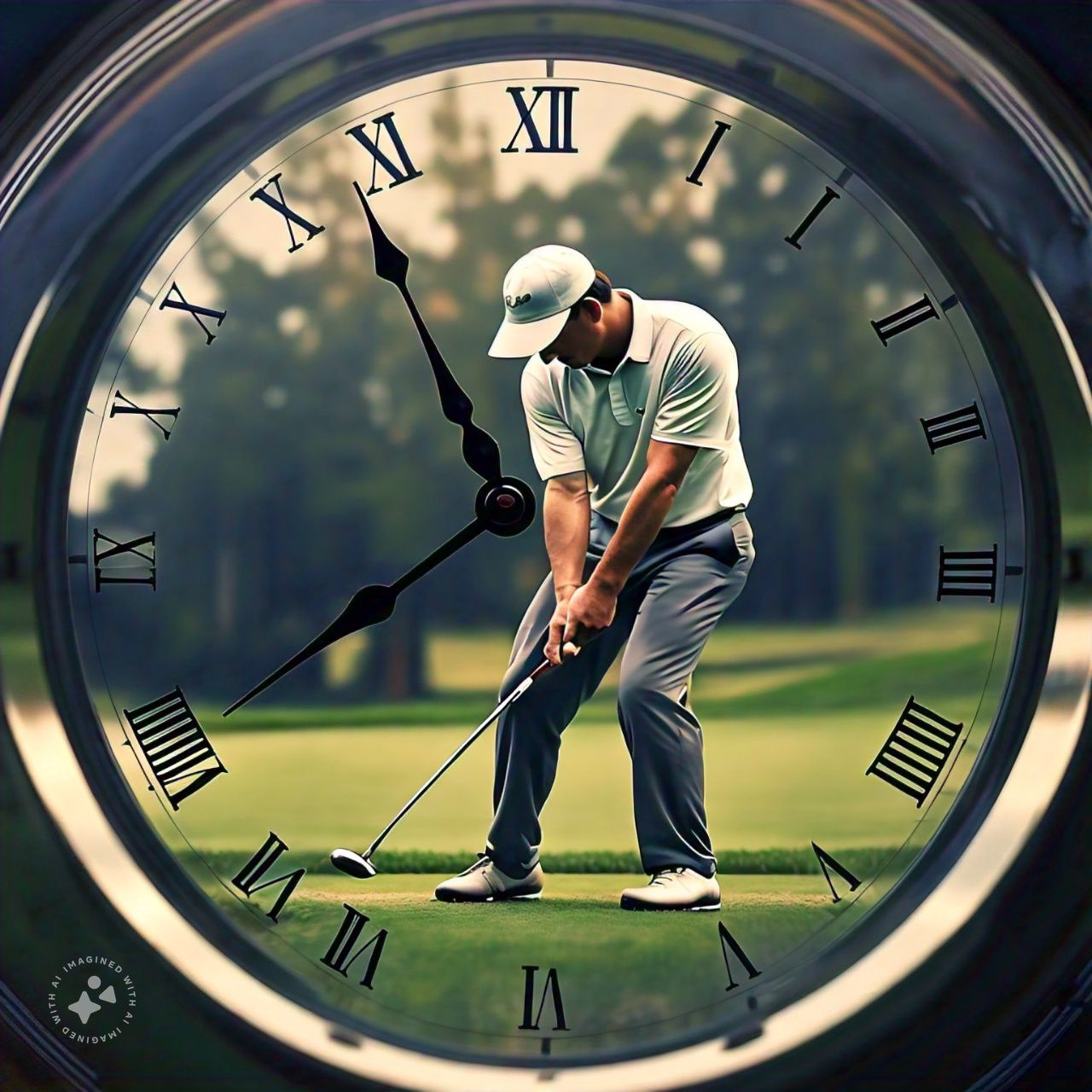
The approach shot in golf is a crucial play, typically taken from the fairway or rough to land the ball on the green. This shot is usually the second or third one after the tee shot, depending on the distance to the green and the golfer’s strategy.
Common Types of Approach Shots
Iron, Pitch, and Chip shots can all be used as we approach the green, depending on the distance. The Iron Shot is a full-length shot and, therefore, distinct from the other two. It is important to make a distinction between the Pitch shot and the Chip shot.
Pitch Shot
A pitch shot is a lofted shot that travels more in the air with a high trajectory, typically used to get the ball over an obstacle like a bunker and land it softly on the green. It is ideal when you are farther from the green and need to carry the ball over rough surfaces or hazards, especially when you need the ball to stop quickly after landing.
Chip Shot
In contrast, a chip shot is a low-trajectory shot that spends more time rolling on the ground than in the air, usually played with a less lofted club like the irons. This shot is best used when you are close to the green and there are no significant obstacles between you and the hole, making it perfect for situations where you want the ball to roll out towards the hole after landing.
In summary, choose a pitch shot for higher ball flight with softer landings and a chip shot for lower, rolling approaches when you have a clear path to the hole.
Key Aspects of the Approach Shot
The main goal of the approach shot is to position the ball close to the hole, setting up a potential birdie or par putt. As stated earlier, approach shots can range from short chips, and pitch shots to long iron shots, depending on the distance to the green. Precision is vital, as a poorly placed approach shot can make it challenging to save par. Several factors influence the shot, including the type of club used, the lie of the ball, the slope of the fairway, and the wind, all of which play significant roles in determining the ideal approach shot. Irons shots and chip shots will be the subject of other posts while this post will focus on the pitch shot.
Importance of the Approach Shot
The approach shot is a critical part of golf, requiring skill, precision, and strategy. A well-executed approach shot can lead to a birdie or par, while a poorly executed one can result in a bogey or worse. Experienced golfers keep track of the following statistics to ascertain where they are accumulating strokes unnecessarily and where they need to make adjustments to improve their scoring.
- Strokes Gained
This statistic measures how many strokes a player gains or loses compared to what is expected of the average player on their approach shots. Top players consistently gain strokes in this category. It is often said that the very good players roll 4 shots into 3,or they roll 3 shots into 2. - Greens in Regulation (GIR)
Hitting the green in regulation means landing your approach shot on the green in two strokes on a par 4 or three strokes on a par 5. A high GIR percentage is strongly correlated with lower scores. - Proximity to the Hole
The closer a player can hit their approach shot to the hole, the more birdie opportunities they will have. This statistic measures the average distance a player’s approach shots land from the hole. - Up-and-Down Percentage
This measures how often a player can get up and down for par after missing the green. A high up-and-down percentage indicates a player’s ability to recover from missed approach shots. - To improve the statistics listed above, it is important to be able to hit the ball to the green from different distances, especially from 100 metres in. One way to achieve this is by using the Clock System.
The Clock System for Distance Control
The clock system is a popular technique used in golf to improve distance control, especially with wedge shots. The clock system visualises the golfer’s swing in terms of a clock face. The golfer’s arms act as the clock hands and different positions on the clock correspond to different swing lengths and, consequently, different shot distances. Using specific arm positions helps golfers achieve more consistent distances with their wedge shots. This method allows golfers to have multiple distance options with each club, making it easier to handle various on-course situations. Knowing the exact distances for different swing lengths helps golfers make more confident and informed decisions on the course.
Practical Application of the Clock System in Golf
Start with the lob wedge and use a chipping stroke, focusing on using your arms without hinging your wrists. This technique executed with the lob wedge ensures the ball has more carry and minimal run, resulting in a tightly grouped shot pattern. This consistency helps you better judge the distance the ball travels with a shorter swing.
Clock Positions and Distances
- 7 to 5 o’clock Position: Swing your arms back to the 7 o’clock position and through to the 5 o’clock position (just outside your ankles). This typically results in a shot that travels about 10 metres.
- 8 to 4 o’clock Position: Swing your arms back to the 8 o’clock position and through to the 4 o’clock position (around knee height). This usually results in a shot that travels about 20 metres. The exact distances aren’t as crucial as ensuring the difference between the 7 o’clock and 8 o’clock swings is consistent.
- 9 to 3 o’clock Position: Swing your arms back to the 9 o’clock position (waist height) and through to the 3 o’clock position. This should result in a shot that travels about 30 metres.
Introducing the Wrist Hinge
For distances beyond 30 metres, incorporate a wrist hinge. This involves bending your wrists during the backswing to create an angle between the club and your forearms. This movement helps maintain control while generating power. Ensure the club face remains square to the target line for more accurate and powerful shots.
40 Metres. To hit the ball to 40 metres, execute the 9 o’clock swing with a wrist hinge as your hands approach waist height.
50 Metres. Repeat the 9 o’clock swing with a wrist hinge, using a gap wedge to hit the ball to about 50 metres.
60 Metres. Execute the same swing with a pitching wedge to hit the ball to about 60 metres. These distances are rough estimates and may vary depending on whether you use wedges with steel or graphite shafts.
Longer Distances
Use a longer swing with a wrist hinge for distances of 70, 80, and 90 metres.
70 Metres. Swing your arms back to the 10 o’clock position and through to the 2 o’clock position (chest height) with a lob wedge to hit the ball to about 70 metres.
80 Metres. Execute the same swing with a gap wedge to hit the ball to 80 metres.
90 Metres. To get the ball to 90 metres, execute the same swing but with a pitching wedge.
100 Metres: A full swing with a pitching wedge should cover this distance.
Importance of Swing Rhythm
Swing rhythm, or tempo, is crucial for consistency and accuracy. A smooth, repeatable rhythm ensures all parts of your swing work harmoniously, helping you hit the ball more accurately and with better control. Good rhythm maintains your balance throughout the swing, preventing mishits and ensuring the club head is in the right position at impact.
Some top golfers use a metronome or tempo trainer to develop a consistent swing tempo. A metronome produces a steady beat to help athletes maintain a consistent tempo, encouraging focus on the rhythm of the swing rather than just the mechanics.
An inexpensive way to build rhythm in your golf swing is to mirror the backswing using a simple 1-2 count. Count 1 for the length of the backswing and Count 2 from the top of the backswing to impact, allowing the momentum of the swing to carry your hands to the finish position. This simple routine can help you develop a wonderful rhythm, which is critical for short gameplay.
Conclusion
Mastering the approach shot by effectively applying the clock system is an essential skill for any golfer aiming to improve their game. The approach shot can significantly influence your scoring by setting up a potential birdie or par opportunities. This is achieved using the clock system, which offers a structured method to control distances with various clubs, enhancing consistency and versatility on the course ultimately leading to better performance and lower scores.
